Indicative 20-acre master plan visual
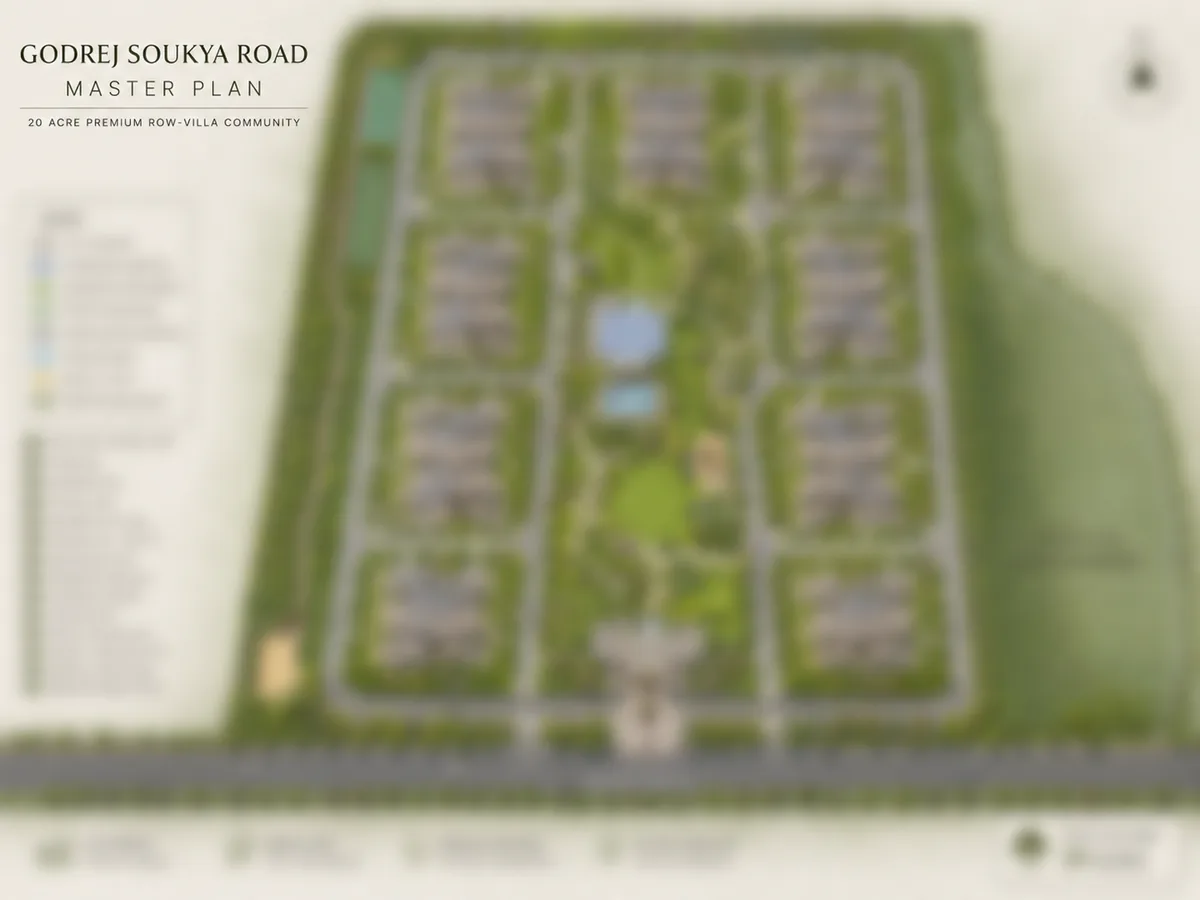
Godrej Soukya Road master plan: the real questions
A master plan is not a decorative aerial view. For Godrej Soukya Road, the question is whether 200-260 row villas on 20 acres can create a calm premium campus while handling vehicles, visitors, fire movement, services and resident amenities. For another Bengaluru planning reference, Godrej Vanantara helps keep attention on density, circulation, landscape depth, and the way residents will move through the community.
The same reading applied to an unsanctioned layout returns almost nothing. Godrej Plots Malur is a plotted campaign for Malur, in Kolar district, with no approved master plan, no disclosed plot count and no Karnataka RERA record — and the 30x40 and 40x60 dimensions in circulation are generic Karnataka site sizes, not a schedule the developer has filed. It is worth seeing what a plan looks like when the brand is present and the sanction is not.
The sanctioned plan should show tower spacing, permanent entry, basement ramps, drop-offs, service routes, utility zones, amenity placement and resident movement.
| Plan element | What to inspect | Why it matters |
|---|---|---|
| Tower spacing | Distance between facing homes | Privacy and ventilation |
| Entry / exit | Resident, visitor and service routes | Daily traffic quality |
| Basement ramps | Position and noise impact | Premium experience |
| Amenity placement | Clubhouse, pool, kids areas | Capacity and convenience |
| Utility zones | STP, DG, waste, transformer | Noise, smell and view impact |
An 20-acre, row-villa plan can work well if the towers are spaced intelligently and internal movement is calm. The sanctioned plan should separate resident entry, visitor movement, service access, fire driveways, basement ramps and pedestrian routes.
The master-plan question is whether the green space is usable after setbacks, ramps, service zones and fire movement. A premium campus should protect privacy, shade, walking loops and senior spaces without forcing everyone through the same crowded core.
In depth
The master plan for a 20-acre row villa community is the document that determines whether the project delivers what its land area promises. A high villa count squeezes margins onto the land, kills landscape, and turns clusters into corridors. A low villa count loses the security and amenity economics that justify a gated community in the first place. Godrej Soukya Road's master plan, in the form being shaped at the pre-launch stage, sits at the row-villa-format sweet spot - roughly 200–260 villas across 20 acres, 60%+ open and landscaped, and the kind of cluster geometry that delivers privacy at the villa scale and community at the campus scale.
This page reads the master plan layer by layer - land use, building placement, green and open space, road and circulation, pedestrian and landscape layers, below-ground utilities, and the sustainability infrastructure that runs underneath all of it.
Land Use Breakdown
| Land Use Component | Indicative % of Total | Indicative Area |
|---|---|---|
| Built footprint (villa plots + clubhouse + utility blocks) | ~30–32% | ~6.0–6.4 acres |
| Landscape, parks, and central green spine | ~45–48% | ~9.0–9.6 acres |
| Sports and amenity outdoor zones | ~8–10% | ~1.6–2.0 acres |
| Internal road network + pedestrian buffers | ~10–12% | ~2.0–2.4 acres |
| STP, transformer yards, service corridors, perimeter buffers | ~4–5% | ~0.8–1.0 acres |
| Total | 100% | 20 acres |
The numbers are indicative pre-launch positioning and will firm at the Karnataka RERA filing. The key signal in the table is the 45%+ allocation to landscape and the 60%+ combined open coverage when sports and pedestrian-buffer areas are added in - both well clear of the apartment-format benchmarks on the corridor.
Building Placement Strategy
Row Villa Clusters
Row villas are arranged in clusters of typically 8–12 units sharing a landscape pocket. Each cluster reads as its own micro-neighbourhood with a shared green node, controlled internal circulation, and a dedicated visitor parking pocket. The cluster geometry - rather than a continuous row-villa strip - is what makes the 20-acre campus livable instead of corridor-like.
4 BHK vs 5 BHK Distribution
The campus is laid out to mix 4 BHK and 5 BHK villas across clusters rather than segregating them into "tiers." Mixed clusters keep the community socially homogenous and preserve resale fungibility - neither configuration gets a "lesser" location on the campus.
Clubhouse and Amenity Cluster
The clubhouse, pool zone, and primary amenity programme sit centrally on the campus, equidistant from most villa clusters. Sports facilities - tennis, basketball, cricket nets, badminton - sit in the perimeter buffer zone, separated from the clubhouse to spread foot-traffic and visual interest across the campus.
Entry Arrival
The arrival sequence reads: external Soukya Road access, security plaza with boom-barrier and biometric controls, a formal forecourt with landscape framing, and direct sightline to the clubhouse pool deck. The arrival is the project's strongest visual moment in row-villa formats - Godrej's recent Bengaluru launches treat this as the campus's signature view.
Road and Circulation Network
Internal Roads
- Two-way carriageway with continuous pedestrian buffer on at least one edge
- Designed for resident traffic (not through-traffic) with traffic-calming geometry - narrowed throats at cluster entries and raised tabletop crossings at landscape spines
- Surface treatment is differential - asphalted main loops and stone-paver finish near clusters
Vehicular Entry and Exit
Single primary entry from Soukya Road with controlled service entry on the secondary edge. The dual-entry geometry is standard practice on 20-acre formats to separate resident movement from service / maintenance / housekeeping flows.
Emergency Access
All clusters are designed to be reachable by fire tender within the National Building Code (NBC) tender-distance norms - typically 18m hose-haul radius from a hard standing.
Parking Strategy
- Each 4 BHK gets two covered parks on its own plot
- Each 5 BHK gets two to three covered parks on its own plot
- Visitor parking is at cluster level (typically 1 visitor park per 4–5 villas)
- No on-road parking - the internal carriageway is kept clear
Below-Ground and Utility Infrastructure
Sewage Treatment Plant (STP)
A dedicated STP sized to community capacity - typically at 1.1x design-population load to allow margin - handles all sewage on site. Treated water is recycled in two loops: landscape irrigation and toilet flushing (via dual plumbing).
Rainwater Harvesting
- Recharge pits at the villa plot level for ground-water recharge
- Storage tanks at community level for the larger landscape and amenity loads
- Designed to capture and reuse the monsoon flow rather than discharging to the storm-water drain
Power Infrastructure
- Underground HT and LT cabling - no overhead lines on the campus
- 100% backup for villa essential loads (lighting, refrigeration, fans, point-load) and 100% backup for common areas
- Provision for EV charging at visitor and cluster parking
Water Supply
- Primary feed: Karnataka Water Supply Board / BWSSB or borewell + tanker mix (corridor stage) with phased BWSSB integration as it reaches the Hoskote belt
- STP reuse loop closes the non-potable load
- Dual plumbing keeps treated water out of the potable loop
Telecom and Smart Infrastructure
- Fiber-to-the-villa with provision for primary + redundant carrier
- Community-wide Wi-Fi at amenity zones
- IoT-ready common-area metering for power and water
Godrej Soukya Road open space and landscape
The useful open-space question is whether it is accessible and shaded. A central lawn, walking loop, kids play area and senior seating have a different value from leftover setbacks.
Green Belt and Open Space Design
Central Green Spine
A continuous landscape spine runs from the forecourt through the central clubhouse zone to the rear boundary, organising the campus into east and west halves. The spine carries the primary pedestrian movement, water features at landscape nodes, and the community lawn and amphitheatre.
Cluster Pockets
Each villa cluster wraps a shared landscape pocket - typically 600–1,000 sqmt of softscape with native planting, seating nodes, and a small water feature or sculpture node. The pockets do the double duty of giving cluster residents a private outdoor amenity and giving the campus its scale of green.
Perimeter Buffer
A continuous planted belt runs along the project's boundary, separating villas from the perimeter road and providing acoustic and visual buffer. The buffer holds the sports facilities and the jogging loop on the inner edge and the mature canopy planting on the outer edge.
Native Planting and Mature Canopy Intent
Plant palette is shaped to native and low-water species with an explicit mature-canopy ambition - the project is designed to read greener in year five than in year one. Species selection favours indigenous trees (Honge, Mahogany, Pongamia, Tabebuia, Gulmohar, Indian Almond) and ground cover that survives Bengaluru's monsoon-summer cycle without supplemental irrigation beyond the STP reuse loop.
Pedestrian Movement and Landscaping
Walking Loop
A continuous walking and jogging loop runs along the perimeter buffer, looping the entire campus inside a single, shaded, traffic-isolated track. At the scale of the project - 20 acres - the loop runs roughly 1.4–1.6 km uninterrupted.
Landscape Nodes
The central green spine carries five to seven landscape nodes - water features, sculpture moments, seating courts, children's play, senior-citizen plaza, and the community amphitheatre. Each node is a destination inside a one-minute walk from at least three villa clusters.
Wayfinding
Cluster-level signage and lighting carry the campus's wayfinding language. Numbering follows a consistent grid - cluster letter, villa number - rather than a postcode-style address so that delivery and emergency services find a villa on the first attempt.
Sustainability Infrastructure
The sustainability spec compounds at villa formats because every villa carries its own roof, garden, and water loop.
Energy
- Solar provision for clubhouse and street-lighting load
- ECBC-compliant clubhouse design for envelope and HVAC efficiency
- 100% LED common-area lighting
- Future-ready solar provision at villa rooftop where elevation allows
Water
- STP reuse covers landscape irrigation and flushing
- Rainwater harvesting designed for ground-water recharge first, storage second
- Native planting palette reduces irrigation load
- Drip and bubbler irrigation in landscape pockets - no overhead sprays
Waste
- Source-segregation at villa level (dry, wet, hazardous)
- Community composting node for organic fraction
- Centralised dry-waste sorting station + tie-up with municipal authorised processors
Certification
- IGBC Gold pre-certification target - Godrej Properties' default sustainability benchmark on Bengaluru launches
Godrej Soukya Road phasing and delivery
If towers are released in phases, early buyers should know what amenities arrive first and what construction continues around them.
Phasing and Construction Logistics
The 20-acre campus is structured for phased construction without disrupting residents who move in during early phases. The phasing strategy - to be confirmed at RERA filing - typically follows clubhouse-first, then villa clusters in concentric phases outward from the central amenity zone. Phasing also informs the cluster-by-cluster handover sequence within the 2029–2030 indicative possession window.
Reading the Master Plan as a Buyer
The signals to look for when the formal master plan is released:
1. Villa count vs 20 acres. Anything materially over 280 villas tightens the density story; anything under 200 lifts price per villa. 2. Open space %. Below 55% changes the lifestyle category. Above 60% holds the row-villa promise. 3. Cluster geometry. Cluster sizes above 14 villas start to read as corridors. Below 8 villas start to lose the cluster-as-neighbourhood logic. 4. Clubhouse-to-villa-count ratio. Below 50 sqft of clubhouse per villa starts to feel cramped at a 200-villa scale; the Parkshire benchmark (32,000+ sqft clubhouse for 1,130 apartments) reads ~28 sqft per home - villa formats typically aim for 60–100 sqft. 5. Pedestrian-loop length. A 1.4 km+ loop is the rule for a campus this size; shorter loops indicate that landscape lost out to building footprint.
The next step on the master plan is the formal release at hard launch with the RERA-registered campus layout, villa-count by configuration, and individual cluster layouts. This site will update with the registered plan as soon as it is on file.
Godrej Soukya Road FAQ
What is Godrej Soukya Road?
Godrej Soukya Road is a proposed premium row villa community by Godrej Properties at Soukya Road, Whitefield. The working brief describes 20 acres, 200-260 row villas, and large 4 BHK and 5 BHK row villas from about 2,800 sq.ft. onwards.
Where is Godrej Soukya Road located?
The site is being tracked near Soukya Road Extension in Whitefield, opposite Goyal Royale Ville and next to the Soukya Road Extension villa precinct. Buyers should confirm final survey numbers, site boundary and approach road in the official documents.
Is Godrej Soukya Road RERA approved?
A project-specific Karnataka RERA registration was not found in public research during this rewrite on 23 May 2026. Do not treat any RERA number, possession date, tower height or unit count as final until the official filing is published.
What is the expected price of Godrej Soukya Road?
The user-provided working price is Rs 3.5 Cr onwards. The final payable cost must be checked against the official cost sheet because GST, stamp duty, registration, floor rise, parking, clubhouse charges, corpus and interiors can materially change the budget.
Which configurations are expected?
The expected mix is 4 BHK and 5 BHK, with homes from approximately 2,800 sq.ft. onwards. The official floor-plan sheet should confirm carpet area, saleable area, balcony area and parking allocation.
Who should shortlist this project?
The strongest fit is a Whitefield-linked family or long-horizon investor looking for a large premium home near the ITPL / Whitefield (Kadugodi) / metro catchment. It is less suitable for buyers who need ready possession or full certainty before RERA publication.
Godrej Soukya Road: Contact us for latest documents
Request the current RERA status, cost sheet, floor-plan sheet, tower release note, payment schedule and site-visit slot before you block an EOI.
Contact us